Ceramic Coils vs. Cotton Mesh Coils: Heat Distribution Compared
Crack open the retail box for a modern pod system, sub-ohm tank, or 510-thread cartridge, and you will almost always encounter one of two dominant atomizer architectures: organic cotton mesh coils or microporous ceramic coils. Ceramic Coils vs. Cotton Mesh Coils: Heat
To an everyday shopper scanning product specs, both promise the exact same benefits on the packaging—“pure flavor,” “zero dry hits,” and “extended coil longevity.” Yet once you fill the reservoir and take your first three draws, the two technologies behave completely differently in your hand and on your palate. Ceramic Coils vs. Cotton Mesh Coils: Heat
One fires up in milliseconds, flooding your tongue with warm, sweet, high-density vapor clouds—but scorches instantly if you ever let the tank run dry. The other takes a beat longer to warm up, holds steady thermal mass across long draws without burning, and handles ultra-thick liquids effortlessly—yet mutes delicate fruit top notes if paired with the wrong e-liquid. Ceramic Coils vs. Cotton Mesh Coils: Heat
In this comprehensive technical and editorial comparison of Ceramic Coils vs. Cotton Mesh Coils: Heat Distribution Compared, we examine the thermodynamics inside each heating core, contrast capillary cotton wicking against microporous ceramic thermal diffusion, break down ramp-up speed, flavor clarity, and sweetener gunk resistance, and show you exactly which coil architecture wins for your specific setup. Ceramic Coils vs. Cotton Mesh Coils: Heat
1. How Heat Moves Inside Each Atomizer: Thermodynamics & Wicking Physics
Every vape atomizer solves the same fundamental engineering challenge: how to transport liquid to a hot metal element and vaporize it cleanly between 380°F and 430°F (193°C–221°C) without creating localized hot spots. Ceramic Coils vs. Cotton Mesh Coils: Heat
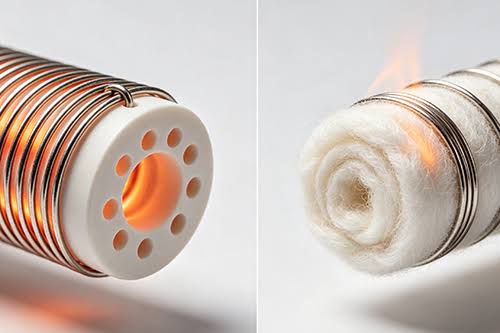
  THERMAL DISTRIBUTION: COTTON MESH COIL VS. MICROPOROUS CERAMIC COIL

  Organic Cotton Mesh Coil (Direct Surface Contact):
  [ Perforated Metal Mesh Grid ] ──► Heats in <50ms ──► Direct contact with saturated cotton fibers
                                 ──► Rapid, explosive surface vaporization + high vapor density

  Microporous Ceramic Coil (Embedded Thermal Mass):
  [ Internal Wire / Trace ] ──► Heats porous ceramic block ──► Uniform 360° radiant thermal diffusion
                            ──► Liquid drawn through micron pores ──► Smooth, steady, scorch-free aerosol
1. Cotton Mesh Coils: High-Speed Surface Area & Capillary Flow
In a cotton mesh coil (such as Vaporesso COREX, Geekvape Z Mesh, or Uwell Pro-FOCS), a thin sheet of FeCrAl (Kanthal) or stainless steel is laser-etched into a honeycomb or diamond grid and pressed flush against layers of unbleached Japanese organic cotton. Ceramic Coils vs. Cotton Mesh Coils: Heat
How Heat Distributes: Because the metal mesh is paper-thin and pressed directly against wet cotton, electrical current heats the entire grid almost instantaneously (under 50 milliseconds). Thousands of tiny cotton fibers act like microscopic straws, pulling e-liquid via capillary action across every square millimeter of the mesh.
Thermal Behavior: Extremely fast ramp-up and rapid cool-down once you release the fire button, paired with massive vapor output per watt.
- Ceramic Coils vs. Cotton Mesh Coils: Heat
2. Ceramic Coils: Radiant Thermal Inertia & Microporous Diffusion
In a ceramic coil (pioneered in modern vaping by CCELL and Vaporesso CCELL architectures), the metal heating wire or conductive trace is sintered directly inside a rigid cylinder of food-grade porous ceramic perforated with millions of microscopic 10-to-20-micron channels. Ceramic Coils vs. Cotton Mesh Coils: Heat
How Heat Distributes: Instead of bare metal touching liquid directly, the embedded wire heats the surrounding ceramic matrix first. Ceramic acts as a thermal diffuser and heat sink—absorbing localized spikes from the wire and radiating uniform, even heat across all 360 degrees of its porous walls.
Thermal Behavior: Slower initial warm-up (thermal lag), higher heat retention between consecutive puffs, and virtually zero localized hot spots.
- Ceramic Coils vs. Cotton Mesh Coils: Heat
2. Master Comparison Matrix: Ceramic Coils vs. Cotton Mesh Coils
Compare both atomizer technologies side-by-side across heat distribution, flavor accuracy, viscosity tolerance, and durability: Ceramic Coils vs. Cotton Mesh Coils: Heat
+----------------------------------------------------------------------------------------------------+
|                 CERAMIC COILS VS. COTTON MESH COILS: MASTER TECHNICAL COMPARISON MATRIX            |
+------------------------------+-----------------------------------+---------------------------------+
| Performance & Engineering    | Organic Cotton Mesh Coils         | Microporous Ceramic Coils       |
| Metric                       | (FeCrAl / SS316L Mesh + Cotton)   | (Sintered Porous Ceramic Core)  |
+------------------------------+-----------------------------------+---------------------------------+
| Heat Distribution Pattern    | Instant, direct surface heating   | Gradual, uniform 360° radiant   |
|                              | across wide perforated metal grid.| heat diffusion through ceramic. |
+------------------------------+-----------------------------------+---------------------------------+
| Ramp-Up & Cool-Down Speed    | Ultra-Fast (<0.05s ramp-up;       | Moderate-Slow (0.3–0.8s ramp-up;|
|                              | cools immediately post-puff).     | retains heat after puff ends).  |
+------------------------------+-----------------------------------+---------------------------------+
| Flavor Profile & Clarity     | Vibrant, sweet, saturated, &      | Clean, neutral, crisp, & zero   |
|                              | full-bodied (best for e-liquids). | "cotton break-in" note.         |
+------------------------------+---------------------------------+---------------------------------+
| Vapor Cloud Density          | High to Massive (wide surface     | Moderate & silky (refined,      |
|                              | area vaporizes more liquid/sec).  | controlled aerosol droplets).   |
+------------------------------+---------------------------------+---------------------------------+
| Scorch & Dry-Hit Resistance  | Low — bare cotton chars instantly | High — ceramic does not burn or |
|                              | if fired dry for even 0.5 secs.   | char at standard vaping temps.  |
+------------------------------+---------------------------------+---------------------------------+
| Ideal Liquid Viscosity       | Standard 50/50 VG/PG nic salts &  | High-viscosity botanical oils,  |
|                              | 70/30 high-VG freebase e-liquids. | distillates & thin 50/50 salts. |
+------------------------------+---------------------------------+---------------------------------+
3. Flavor, Ramp-Up & Cloud Production: Real-World Differences
When you put a ceramic coil and a cotton mesh coil side-by-side at the exact same wattage, three sensory differences stand out immediately: Ceramic Coils vs. Cotton Mesh Coils: Heat
1. The “First-Puff” Break-In Experience
Cotton Mesh Coils: Even with top-tier unbleached organic cotton, the first 10 to 15 puffs on a brand-new cotton coil often carry a faint, earthy “new cotton” undertone until the fibers season completely with e-liquid.
Ceramic Coils: Because ceramic is completely inert and odorless, puff number one tastes 100% pure with zero break-in flavor—one of the primary reasons ceramic dominates terpene-rich botanical cartridges and delicate tobacco blends.
- Ceramic Coils vs. Cotton Mesh Coils: Heat
2. Sweetness & Mid-Range Flavor Saturation
Cotton Mesh Coils Win for Standard E-Liquids: When vaping multi-layered fruit candies, iced berries, or rich vanilla custards in a pod kit or sub-ohm tank, cotton mesh coils deliver noticeably bolder sweetness and thicker vapor density. Organic cotton holds a higher volume of liquid right against the mesh grid, vaporizing larger droplets that coat your palate immediately.
Ceramic Can Taste Slightly “Drier” With High-VG Juice: Because ceramic pores feed liquid at a measured, steady rate rather than flooding the surface, thick 70/30 VG/PG e-liquids can sometimes feel slightly lighter or drier on a ceramic coil compared to a wide-open mesh coil.
- Ceramic Coils vs. Cotton Mesh Coils: Heat
3. Chain-Vaping Heat Buildup
Cotton Mesh Coils Shed Heat Fast: Because thin metal foil has almost zero thermal mass, the coil drops back toward room temperature within seconds after you stop inhaling.
Ceramic Coils Retain Thermal Momentum: Ceramic holds onto heat much like a stoneware baking dish. On your first cold puff, a ceramic coil needs an extra half-second to reach full vaporization temperature; on your third consecutive puff, that stored warmth makes the ceramic coil fire instantly and smoothly.
- Ceramic Coils vs. Cotton Mesh Coils: Heat
4. Which Coil Type Lasts Longer? Sweetener Gunk vs. Cotton Scorching
One of the most common myths in vaping is that “ceramic coils last forever because ceramic can’t burn.” While half of that statement is scientifically true, real-world longevity depends on what kind of liquid you vape: Ceramic Coils vs. Cotton Mesh Coils: Heat
  HOW EACH COIL TYPE EVENTUALLY WEARS OUT

  Cotton Mesh Coil Failure Modes:
  [ 1. Accidental Dry Fire ] ──► Cotton chars black instantaneously (0.5 seconds = coil ruined).
  [ 2. Sucralose Caramelization ] ──► Sweetener bakes dark crust onto mesh & cotton over 7–14 days.

  Ceramic Coil Failure Modes:
  [ 1. Zero Cotton Scorching ] ──► Survives brief dry heat without burning or tasting like ash!
  [ 2. Microscopic Pore Clogging ] ──► Heavy sucralose sweeteners & thick plant waxes gradually clog
                                       the 15-micron ceramic pores, muting flavor & restricting flow.
The Real-World Lifespan Verdict
With Unsweetened or Lightly Sweetened Liquids / Botanical Oils: Ceramic coils easily outlast cotton mesh coils by 2x to 3x, maintaining clean flavor across multiple refills without fibrous breakdown.
With Hyper-Sweet “Bar Salt” or Dessert E-Liquids: Sucralose sweetener caramelizes at high temperatures regardless of whether the coil is ceramic or cotton. Once baked carbon fills ceramic’s microscopic pores, capillary flow slows down and flavor dulls—giving both coil types a practical lifespan of roughly 1 to 2 weeks with heavy sweeteners.
- Ceramic Coils vs. Cotton Mesh Coils: Heat
5. How to Choose: When to Pick Cotton Mesh vs. Ceramic Coils
Match your hardware and e-liquid directly to the right heating core: Ceramic Coils vs. Cotton Mesh Coils: Heat
  QUICK SELECTION GUIDE: COTTON MESH VS. CERAMIC COILS

  CHOOSE COTTON MESH COILS IF YOU WANT:
  ✓ Maximum flavor saturation and sweetness from 50/50 nic salts or 70/30 freebase e-liquids.
  ✓ Instant zero-lag ramp-up speed on auto-draw pod systems (e.g., XROS, Xlim, Caliburn).
  ✓ Dense, voluminous clouds on sub-ohm tanks (0.15Ω – 0.4Ω at 30W–90W).

  CHOOSE CERAMIC COILS IF YOU WANT:
  ✓ Pure, neutral terpene and flavor fidelity with zero "cotton break-in" aftertaste.
  ✓ Superior handling of ultra-thick oils, distillates, or high-viscosity concentrates.
  ✓ High resistance to accidental dry-hit scorching and smooth, even 360° heat distribution.
A Note on Hybrid “Ceramic-Cotton” Coils
Recognizing the complementary strengths of both materials, several manufacturers (including Vaporesso CCELL pods and specialized MTL coils) wrap a thin outer layer of organic cotton around a central porous ceramic core. The outer cotton feeds liquid rapidly from the tank ports, while the inner ceramic cylinder shields the cotton from direct metal hot spots—combining fast wicking with smooth, burn-resistant heat distribution. Ceramic Coils vs. Cotton Mesh Coils: Heat
Final Verdict
Comparing Ceramic Coils vs. Cotton Mesh Coils: Heat Distribution Compared reveals two distinct engineering philosophies built for different jobs. Organic cotton mesh coils excel at rapid, high-surface-area heat transfer—delivering instant ramp-up, rich sweetness, and dense vapor clouds for everyday 50/50 nic salts and 70/30 high-VG e-liquids. Microporous ceramic coils shine through uniform 360-degree radiant thermal diffusion, eliminating localized hot spots, preventing cotton-scorch dry hits, preserving pure flavor with zero break-in taste, and effortlessly vaporizing thick, high-viscosity oils. Choose cotton mesh for vibrant daily e-liquid flavor and clouds, and turn to ceramic whenever thermal stability, oil viscosity, and pure, scorch-free consistency matter most. Ceramic Coils vs. Cotton Mesh Coils: Heat
Frequently Asked Questions
What is the main difference between ceramic coils and cotton mesh coils?
The core difference lies in the wicking medium and how heat spreads across it. Cotton mesh coils wrap a wide, perforated metal grid inside organic Japanese cotton, delivering near-instant ramp-up speed, dense vapor clouds, and vibrant flavor for standard PG/VG e-liquids. Ceramic coils embed a heating element inside a microporous ceramic cylinder (such as CCELL technology), distributing heat slowly and evenly without burning—making them ideal for thick, high-viscosity oils and high-temperature sessions. Ceramic Coils vs. Cotton Mesh Coils: Heat
Do ceramic coils produce better flavor than cotton mesh coils?
For standard nicotine e-liquids (both 50/50 nic salts and 70/30 high-VG freebase), organic cotton mesh coils generally produce brighter, sweeter, and denser flavor because cotton feeds liquid faster to a large surface-area mesh grid. Ceramic coils deliver a cleaner, more neutral taste with zero ‘cotton break-in’ note and excel with thick botanical extracts or high-heat draws where cotton would scorch. Ceramic Coils vs. Cotton Mesh Coils: Heat
Do ceramic vape coils last longer than cotton mesh coils?
Physically, ceramic resists charring and high-heat oxidation far better than organic cotton fibers, allowing ceramic cores to survive dry heat without burning. However, in sweet nicotine e-liquids, sucralose sweetener still caramelizes inside ceramic’s microscopic pores—meaning both coil types typically deliver 1 to 3 weeks of clean flavor depending on e-liquid sweetness. Ceramic Coils vs. Cotton Mesh Coils: Heat