USB-C Quick Charging vs. Standard Micro-USB in Modern Vapes
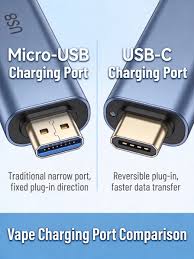
Anyone who vaped prior to 2020 remembers the daily frustration of Micro-USB charging ports: squinting in dim light to figure out which side of the trapezoid plug faced up, wiggling a frayed cable at a 45-degree angle just to get the charging icon to blink, waiting two full hours for a 1000mAh battery to top off, and eventually watching the fragile socket loosen from the motherboard altogether. USB-C Quick Charging vs. Standard Micro-USB
Fast-forward to 2026, and USB Type-C (USB-C) has become the undisputed universal standard across virtually every refillable pod kit, high-wattage box mod, and multi-thousand-puff rechargeable disposable. Yet upgrading from Micro-USB to USB-C introduced more than just a reversible oval plug—it brought 2A and 3A quick-charging speeds, smarter Battery Management System (BMS) thermal controls, and a puzzling quirk where brand-new vapes sometimes refuse to charge when plugged into modern smartphone or laptop USB-C to USB-C Power Delivery (PD) chargers. USB-C Quick Charging vs. Standard Micro-USB
In this comprehensive technical and editorial comparison of USB-C Quick Charging vs. Standard Micro-USB in Modern Vapes, we break down the electrical and mechanical differences between both standards, explain how CC/CV charging curves protect lithium-ion cells during 30-minute fast charges, solve the mystery of why USB-C to USB-C cables fail on certain devices, and outline best-practice charging habits for built-in pods and removable-cell box mods. USB-C Quick Charging vs. Standard Micro-USB
1. Beyond the Reversible Plug: Electrical & Mechanical Differences
While the reversible oval shape of USB-C gets all the everyday praise, the real performance upgrades happen inside the connector pins and the charging circuit board behind them: USB-C Quick Charging vs. Standard Micro-USB
  MICRO-USB (LEGACY STANDARD) VS. USB TYPE-C (MODERN VAPE STANDARD)

  Standard Micro-USB (5-Pin Asymmetric Plug):
  [ 5V / 0.5A – 1.0A Max Input ] ──► 2.5W–5W Power ──► 90–150 mins for 1000mAh pod
                                 ──► Fragile retention clips wear out after ~1,500 insertions

  Modern USB-C Quick Charging (24-Pin Reversible Plug):
  [ 5V / 2.0A – 3.0A Input ]     ──► 10W–15W Power ──► 25–40 mins for 1000mAh pod
                                 ──► Heavy-duty center tongue rated for 10,000+ insertions
Three Engineering Leaps With USB-C
Double to Triple Charging Speed (2A–3A vs. 0.5A–1A): Legacy Micro-USB ports on early vape sticks typically maxed out at 0.5A to 1.0A (2.5W to 5W)—requiring nearly two hours to charge a modest 1000mAh internal battery. Modern USB-C pod kits (such as the Vaporesso XROS Pro, OXVA Xlim Pro 2, and Uwell Caliburn G3) safely accept 5V/2A (10W)—taking a depleted 1000mAh–1200mAh pod battery from 0% to 80% in just 20 to 25 minutes.
6x Longer Mechanical Port Lifespan: Micro-USB plugs relied on two tiny spring-loaded metal hooks on the outside of the cable tip that bent easily, loosening the female port inside the vape. USB-C places spring retention clips inside the replaceable cable plug rather than the device socket—boosting port durability to 10,000+ plug cycles.
Thicker Power Pins & Better Thermal Dissipation: USB-C’s 24-pin symmetrical architecture dedicates multiple parallel pins to VBUS (power) and GND (ground), lowering electrical resistance at the plug interface so the connector stays cool even during 2A fast charging.
- USB-C Quick Charging vs. Standard Micro-USB
2. Master Comparison Matrix: USB-C Quick Charging vs. Micro-USB
Compare legacy Micro-USB and modern USB-C across charging time, safety circuitry, cable compatibility, and everyday reliability: USB-C Quick Charging vs. Standard Micro-USB
+----------------------------------------------------------------------------------------------------+
|                 USB-C QUICK CHARGING VS. STANDARD MICRO-USB MASTER COMPARISON MATRIX               |
+------------------------------+-----------------------------------+---------------------------------+
| Specification / Metric       | Standard Micro-USB (Legacy)       | USB-C Quick Charging (2026)     |
+------------------------------+-----------------------------------+---------------------------------+
| Connector Orientation        | Asymmetric one-way trapezoid      | Fully reversible 24-pin oval    |
|                              | (easy to insert upside down).     | (plugs in cleanly either way).  |
+------------------------------+-----------------------------------+---------------------------------+
| Typical Charging Current     | 0.5A – 1.0A at 5V (2.5W – 5W)     | 2.0A – 3.0A at 5V (10W – 15W)   |
+------------------------------+-----------------------------------+---------------------------------+
| 0% to 100% Charge Time       | 90 to 150 minutes                 | 30 to 45 minutes                |
| (1000mAh Pod Battery)        |                                   | (0% to 80% in ~20–25 minutes)   |
+------------------------------+---------------------------------+---------------------------------+
| Mechanical Port Durability   | Low-Moderate (~1,500 cycles;      | High (10,000+ cycles; robust    |
|                              | hooks bend & loosen easily).      | internal tongue architecture).  |
+------------------------------+-----------------------------------+---------------------------------+
| Smartphone / Laptop Cable    | Universal with any USB-A to       | Works with ALL USB-A-to-USB-C   |
| Compatibility                | Micro-USB cable.                  | cables; budget devices may fail |
|                              |                                   | on USB-C-to-USB-C PD cables.    |
+------------------------------+---------------------------------+---------------------------------+
| BMS Thermal & Overcharge     | Basic trickle cutoffs; slower     | Multi-stage CC/CV chips with    |
| Chipset Sophistication       | balancing on dual-cell mods.      | thermal & voltage protection.   |
+------------------------------+-----------------------------------+---------------------------------+
3. Does 2A Fast Charging Hurt Vape Battery Lifespan? (Inside the BMS)
A common concern among careful vapers is whether pushing 2 amps into a compact 1000mAh pod battery shortens its long-term lifespan compared to slow 1A Micro-USB charging. USB-C Quick Charging vs. Standard Micro-USB
  HOW MODERN VAPE BMS CHIPS PROTECT CELLS DURING USB-C QUICK CHARGING (CC/CV CURVE)

  [ 0% ──► 75% Charge (Constant Current Phase — Full 2.0A Speed) ]
  Battery voltage is low (3.3V–3.9V) ──► Cell absorbs 2A cleanly with minimal heat generation.

  [ 75% ──► 100% Charge (Constant Voltage Phase — Automatic Tapering) ]
  Battery nears 4.20V ceiling ──► BMS automatically throttles current down (1.0A ──► 0.4A ──► 0.0A)
                              ──► Prevents over-voltage stress & terminates charge cleanly!
Why Quality USB-C Pod Systems Charge Fast Without Overheating
Modern open-system pod kits integrate dedicated Constant-Current / Constant-Voltage (CC/CV) Battery Management System (BMS) chips:
Fast Early Top-Ups: When your lithium cell sits between 10% and 70% capacity, internal chemical resistance is low, allowing the BMS to safely feed 2.0A for a rapid 15-minute boost before you head out the door.
Gentle Finishing Taper: Once the cell reaches 4.05V–4.10V (~80% full), the BMS gradually steps amperage down—finishing the final 20% gently at 4.20V without stressing the lithium electrolyte.
The One Caveat: Always charge on a cool, flat surface (never under a pillow or on a sunny dashboard) and unplug your device once the LED turns solid green or displays 100%.
- USB-C Quick Charging vs. Standard Micro-USB
4. The #1 USB-C Mystery Solved: Why USB-C to USB-C Cables Often Fail
Have you ever plugged your USB-C pod vape or disposable into a modern MacBook, iPad, or Samsung fast-charger brick using a USB-C to USB-C cable, only for the device’s screen or LED to stay completely dark? USB-C Quick Charging vs. Standard Micro-USB
Your vape isn’t broken—you just ran into the 5.1kΩ CC Resistor Handshake Rule:
  WHY USB-A-TO-USB-C WORKS EVERY TIME WHILE USB-C-TO-USB-C SOMETIMES FAILS

  [ USB-A to USB-C Cable + 5V Wall Block ]
  Always outputs steady 5V baseline power immediately ──► Works on 100% of vapes & disposables!

  [ USB-C to USB-C Power Delivery (PD) Cable + 45W–100W Laptop Brick ]
  Smart PD brick waits for a "5.1kΩ CC resistor handshake" from the vape before turning on power.
  Budget vapes & disposables lack those two $0.01 resistors ──► Brick stays at 0V (Zero Charge)!
The 5-Second Solution: Keep the short USB-A to USB-C cable included inside your vape’s retail box, or plug any standard USB-A to USB-C cable into a classic rectangular 5V/1A or 5V/2A phone wall block (or computer USB-A port). Because legacy USB-A ports supply 5 volts continuously without waiting for a digital PD handshake, they charge 100% of USB-C vapes reliably.
- USB-C Quick Charging vs. Standard Micro-USB
5. USB-C Charging on Removable-Battery Box Mods: Internal vs. External
If you use a regulated box mod powered by removable 18650 or 21700 batteries, almost all modern mods feature a 2A USB-C port with onboard balance charging. Should you use it, or stick to an external bay charger?
External Smart Bay Chargers Still Win for Daily Home Use: Dropping your 18650 or 21700 cells into a dedicated Nitecore, XTAR, or Miboxer smart charger eliminates mechanical wear on your mod’s USB-C port, keeps charging heat outside your mod’s chipset housing, and monitors each cell’s internal resistance independently.
USB-C Onboard Charging Is Great for Travel & Emergency Top-Ups: Unlike older Micro-USB dual-battery mods—which frequently charged Battery A to 4.25V while leaving Battery B at 4.05V—modern USB-C chipsets (such as Evolv DNA, Vaporesso AXON, and Geekvape AS chips) include true individual cell balance-charging circuits that are completely safe for weekend trips when you don’t want to pack a bulky bay charger.
- USB-C Quick Charging vs. Standard Micro-USB
6. Four Smart Habits to Keep Your Vape’s USB-C Port Working Like New
Even though USB-C ports are vastly tougher than Micro-USB, keeping them clean ensures full 2A charging speed for years: USB-C Quick Charging vs. Standard Micro-USB
+----------------------------------------------------------------------------------------------------+
|                      FOUR SIMPLE HABITS TO PROTECT YOUR VAPE'S USB-C CHARGING PORT                 |
+----+------------------------------------+----------------------------------------------------------+
| #  | Charging Best Practice             | Why It Extends Port & Battery Longevity                  |
+----+------------------------------------+----------------------------------------------------------+
| 1  | Clear Pocket Lint Monthly          | Compacted lint inside the oval USB-C socket prevents the |
|    |                                    | plug from clicking flush—sweep gently w/ wood toothpick. |
+----+------------------------------------+----------------------------------------------------------+
| 2  | Pull Straight Out (Never Wiggle)   | Gripping the plug housing and pulling straight out avoids|
|    |                                    | prying against the center circuit tongue inside the port.|
+----+------------------------------------+----------------------------------------------------------+
| 3  | Never Vape While Plugged In        | Avoid pass-through vaping so the battery never experiences|
|    |                                    | simultaneous charge/discharge heat or cord leverage.     |
+----+------------------------------------+----------------------------------------------------------+
| 4  | Keep E-Liquid Out of the Socket    | Always wipe leaked pod juice dry before plugging in a    |
|    |                                    | cable so sugary liquid never caramelizes on the pins.    |
+----+------------------------------------+----------------------------------------------------------+
Final Verdict
Comparing USB-C Quick Charging vs. Standard Micro-USB in Modern Vapes demonstrates why Micro-USB has been completely retired across modern vaping hardware. USB-C delivers 2x to 3x faster charging speeds (25–40 minutes vs. 2 hours), six times greater mechanical port durability, smarter CC/CV thermal protection, and effortless reversible convenience. Use a standard USB-A to USB-C cable paired with a 5V/1A or 5V/2A wall adapter for universal compatibility across every pod kit and disposable, keep pocket lint cleared from the oval port, and let your device reach a cool, uninterrupted charge before taking your next puff. USB-C Quick Charging vs. Standard Micro-USB
Frequently Asked Questions
Is USB-C 2A quick charging safe for pod vapes and built-in batteries?
Yes, provided the vape’s Battery Management System (BMS) is engineered for 2A input and you use a standard 5V wall adapter. Modern pod systems like the Vaporesso XROS Pro, OXVA Xlim Pro 2, and Uwell Caliburn G3 regulate incoming current smoothly and taper amperage down once the cell reaches 80% capacity to prevent overheating. USB-C Quick Charging vs. Standard Micro-USB
Why won’t my USB-C vape charge when I use my phone or laptop’s USB-C to USB-C cable?
Many compact pod vapes and disposables omit the two 5.1k-ohm CC (Configuration Channel) pull-down resistors required by the USB Power Delivery (PD) protocol. When plugged into a smart USB-C to USB-C PD charger, the power brick detects no handshake signal and refuses to send voltage. Switching to a standard USB-A to USB-C cable plugged into a 5V/1A or 5V/2A brick solves the issue immediately. USB-C Quick Charging vs. Standard Micro-USB
Should I charge removable 18650 or 21700 batteries through my box mod’s USB-C port?
While modern dual-battery USB-C mods include balance-charging chips capable of occasional travel top-ups, using a dedicated external smart bay charger (such as Nitecore or XTAR) remains safer and better for long-term cell health—eliminating mechanical wear on the mod‘s solder joints and ensuring precise individual cell balancing. USB-C Quick Charging vs. Standard Micro-USB